Food Storage
The 2-Week Emergency Food Supply List You Can Shop From Today
July 4, 2026 · 2min read · Reviewed against FEMA & CDC guidance
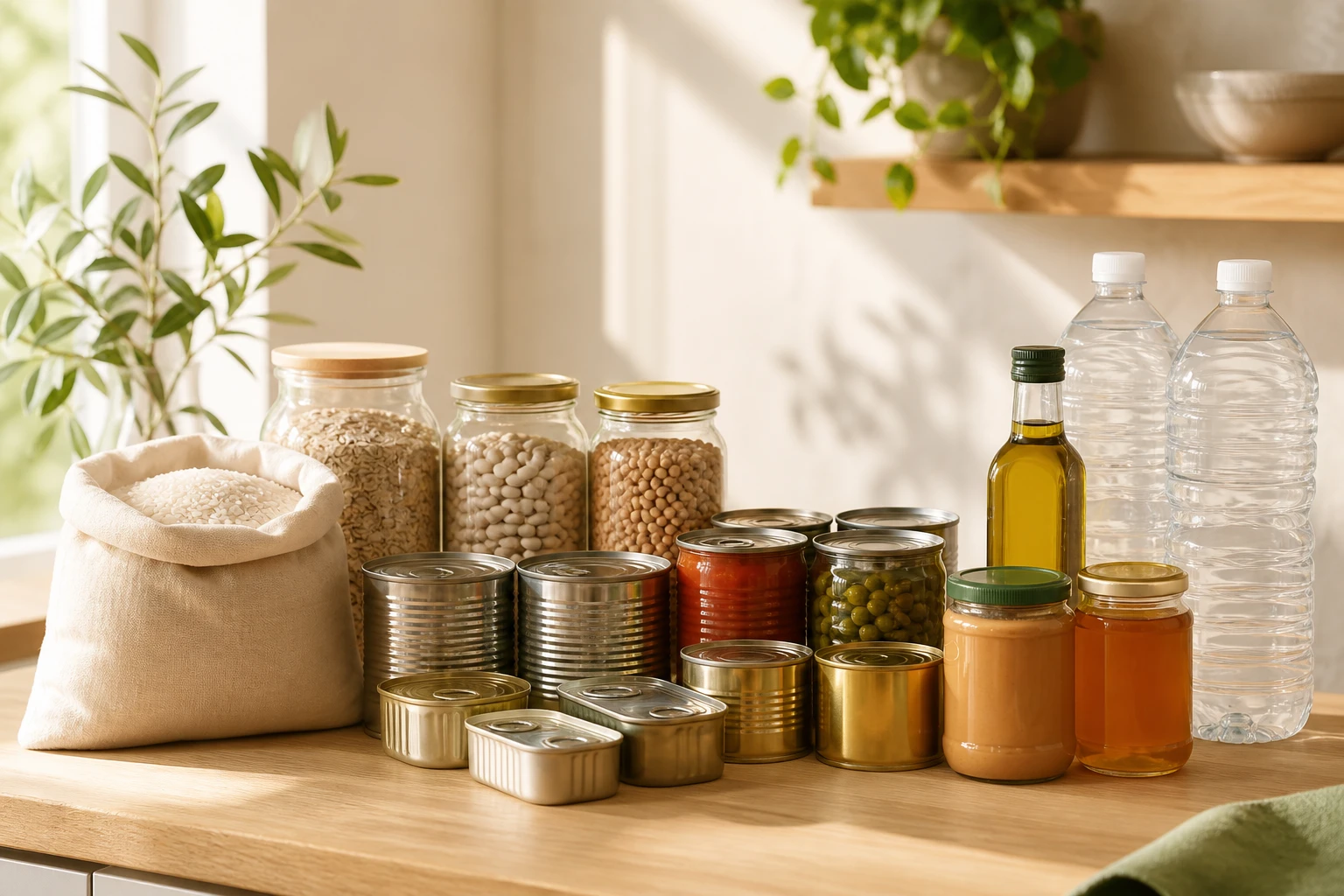
Most emergency food lists fail in one of two ways: they're vague ("stock up on canned goods"), or they're a catalog page for $400 freeze-dried buckets. This one is neither. It's a complete two-week supply built from a normal grocery store, with the math shown.
The target, per person, is 14,000 calories (2,000 per day, FEMA's planning minimum) plus 14 gallons of water. Multiply by your household size. For the full family-of-4 breakdown, see how much emergency food a family of 4 needs.
The list, per person
Everything below is shelf-stable, needs no refrigeration, and can be cooked with nothing more than boiling water (and much of it with no cooking at all).
Base staples (roughly 8,000 calories)
- 3 lbs rice
- 2 lbs pasta
- 2 lbs oats
- 1 lb crackers
Protein (roughly 3,500 calories)
- 4 cans beans
- 3 cans tuna, chicken, or salmon
- 1 jar peanut butter
- 1 lb nuts or trail mix
Fruits, vegetables, and soups (roughly 1,500 calories)
- 6 cans vegetables
- 4 cans fruit
- 3 cans soup or chili
- Dried fruit
Fats and morale (roughly 1,500+ calories)
- Cooking oil, small bottle
- Honey or sugar
- Coffee or tea, chocolate, hard candy
Water: 14 gallons (a case of bottles plus two 5-gallon jugs gets you close; full options in the water storage guide)
The non-food items that make the food usable
- Manual can opener (the single most forgotten item in emergency prep)
- Camp stove or grill, with fuel stored safely outside
- Matches or lighters
- Paper plates and utensils, to save wash water
- Trash bags
Three rules that make this list work
1. Store what you actually eat. If your family won't touch canned salmon on a Tuesday, they won't want it during a power outage either. Swap items freely; match the calorie targets, not the exact list.
2. Eat and replace. This isn't a bunker stash to seal away. Rotate it through your normal cooking: use the oldest cans, replace them on the next grocery run. Your emergency supply stays fresh forever and nothing expires unnoticed. Shelf-life details in how long canned food really lasts.
3. Spread the cost. Buying this all at once for a family runs a few hundred dollars. Adding $15 to $25 per grocery trip builds it in about two months. There's a full budget plan here.
Print it, shop it, then track it
A list gets you to a stocked pantry. The harder problem is six months later: what's been eaten, what expires next month, and how many days would it actually cover now that your household changed?
Provision Planner keeps the running answer. Scan items with the barcode scanner as you shelve them, and it tracks quantities, expiration dates, and exactly how many days of food and water your household has, updated every time something comes in or out.
You did the reading. Now get your number.
Provision Planner does this article's math for your real household, automatically, and keeps it current as supplies come and go.